
Westminster’s Deed.
And the death of honesty and magnanimity.

“When people describe particularly evil individuals or regimes, why is it that they use the term Nazi or fascist, but almost never communist?”
Whilst this stands as a comparatively uncontroversial question to ask thyself in the United States or even some places in the Western Hemisphere, this exact quote, would have made one a target of the continental European press for “revisionism” or “far-right sympathies.” To add more fuel to the fire, the author of that exact same quote too also suggested that Germany has attempted to atone for the crimes of the Holocaust.
This quote, considering how politically toxic the term “right-wing” is in Western European politics, and for that matter, because the author of the sentence also said whether or not the question of atonement for German guilt for the Second World War and the Holocaust has been answered, would have made whomever said this almost a pariah in any national theater of European politics, as many European nations regard such portion of history in great esteem since it contribute to their national identity as much as Asian countries regard their creation myths. In the eyes of those countries, either out of conviction that they could have never been so monstrously wrong or the discomfort of acknowledgement of what was done by them or in their name, out of political convenience or ideological conviction. “Insult to our nation!” Screams the politicians and the daily rags.
Undeniably, the quote itself is indeed from someone in the United States, and since remembrance is pillar to the identity of many of such nations, the irony can’t be greater since it was Dennis Prager, with relatives lost during the Holocaust, can speak before those nations’ politicians either wipe their glasses or gasping out of shock. For Poles, Czechs, and perhaps Slovaks, the shock isn’t directed at the question of whether communism or Nazism are equally horrific, but the question of German atonement. For the Russians, with many diehard ideologues willingly serving in the invasion of Ukraine who fly either the old Tsarist Russian standard or the Soviet flag, both are blasphemy, because ever since the end of the war, every municipality spends a day celebrating the so-called “Immortal Regiment” and parroting the official line that Poland had collaborated with Nazi Germany, notwithstanding the existence of the Molotov-Ribbentrop Pact that conspicuously erased the period between September 1st, 1939 and the beginning of Operation Barbarossa in 1941, as well as the spread of communism and the continuation of Stalin’s mass terror against supposed subversive groups. Naturally, there is very little need to confirm the existence of Russian imperialism and chauvinism, but to determine the crudeness of it is necessary.
In Western historiography, which is also now shared with many ex-Eastern Bloc countries, the time of communist rule was a period of which many of them see with great disdain, and for greatly justified reasons. The co-optation or destruction of cultural heritage, including their national heroes who served to fight against Nazi occupation like the Polish Home Army or Czechoslovak RAF fighters, the miserable poverty compared to what was happening West of the Iron Curtain, including dependency on Western credit to briefly sustain some form of “modest” living standards (nonetheless miserable by Western standards), and occasional military suppression from the USSR. After the collapse of the Iron Curtain, almost every Eastern European country has conducted investigations and instituted punishments and/or civil penalties onto bureaucrats and informants that were responsible for repression. Before the collapse of the Eastern Bloc, the topic of these countries were, as in the United States, designated as “captive nations.”
But that was in the immediate years leading up to 1989, when most were emaciated and frustrated by the stubbornness of “their” communist regimes, or memories of events such as the 1968 Soviet invasion of Czechoslovakia. In the immediate aftermath of WWII, of course with the exception of the aforementioned Czechoslovaks and Poles who fought alongside the Western allies or conducted guerrilla warfare, everyone was simply relieved that war was over, the Nazis were gone, and the question was how can peace, or how can the new order, be (re)established? After all, those Czechoslovak ex-RAF fighters had to escape to Erding for a reason, and while one can blame Moscow for having planted a puppet regime in Prague, someone local had spied on and denounced them. And perhaps even more poignant is the tale of the permanently exiled Polish Brigadier General Stanislaw Maczek, who was stripped of Polish citizenship by the “anti-fascist” regime in Warsaw, received no pension from Britain because he technically didn’t serve in the British military, and when the city of Breda discovered that General Maczek was in financial difficulties, the Dutch government stayed quiet because angering communist Poland, the Soviet Union, and naturally the United Kingdom, was not a winning position. In the end, Maczek never returned to Poland, and was buried in Breda, after communist Poland fell.
These stories are indeed seldom heard of, and while some memorials have been established and even told today as a reminder of communist oppression and geopolitical expediency, especially the tale of General Maczek, their once decades-long dormancy are testaments to how certain stories and ideas had to be kept low to maintain legitimacy and perhaps, uneasy stability. In the end, even the “heroes” are sinners and can be capable of certainly immoral acts. Of course, one can excuse that geopolitics forces decisionmakers to choose evil in hopes that good may come out of it, or to simply lessen the potential pain. Poles can say that because ‘their’ Warsaw actually belonged to the Kremlin at the time, they couldn’t do anything about General Maczek, but there were stories that even the “victim” can’t claim immunity from coercion.
In the very instance with Maczek and also other Polish servicemen who served on the Western Front, the argument stands the test. Undoubtedly, there were many stories and chapters during that immediate postwar era whose justifications held or didn’t hold the same merit. And since the question at the time was, learning from the mistakes, actual or “supposed,” that enabled WWI and WWII to prevent such a conflict from happening. By that point, the newsreels of Dachau, Bergen-Belsen, and the existence of Auschwitz were revealed, and naturally most ordinary people were horrified. But if what has been said earlier ought to be discounted, then there wouldn’t be a point in why the inner workings of politics, whether domestic or geopolitics, is so intertwined with historiography, and thus the raison d’etre of certain political identities. Once again, to reemphasize, whether it’s me, or Mr. Prager, isn’t talking about justifying German politics of the 1940s or the Holocaust, but how the Holocaust and WWII came to be justified for one of the darkest and most brutal chapters in European history by those, including nominally heroes in Western history, who greenlighted atrocities, a reminder of that Russian way of thinking mentioned above, and the similarities between the “heroes” and the “villains” in terms of ideology and way of thinking; that is, the expulsion of 15 million Germans from their homelands and an accompanying death toll ranging from 600,000 to 2 million.
I. The “Good War” That Never Was
When WWII came to an end, for the West, it was nothing short of a cheerful moment; an end to a war that witnessed the industrialization of extermination and brutalization, the advancement of efficient killing, and the mass application of terrorization of populations as a means to achieve strategic end goals in the form of carpet bombing. That is indeed true; WWII, compared to WWI, was an utter escalation of the methods that was once thought to be destructive to a whole new apex. For much of the Western Allied population, the end was a relief — it was an end to the carnage unleashed, and a stark reminder of the reality that the glory bought in war is paid with blood in equal measure.
But there was a reason to fight and die for: the stop a genuinely evil regime personified by a megalomaniac dictator, whose pursuit of expanding Germany’s Lebensraum (living space) meant genocidal aggression against populations that were either “inferior” or supposedly posed a danger to German destiny. Today, we’re fully aware of Dachau, Bergen-Belsen, and Auschwitz, the mechanisms and the justifications of mass murder, and the willingness to subordinate the individual to the total state that is a complete destruction of morality, therefore we look back upon the punitive treatment of Germany, while the dominant Allied historiography treats as both necessary and perhaps could have been less punitive for a nation that suffered total economic and societal collapse — the immediate post-war era was filled with nothing short of organized pogroms, hunger, and destruction. Most people, at least in the Western world, look back and reflect on these times not with triumph, but of genuine sorrow for the human and moral loss that occurred.
Nevertheless, there do exist people who treat this history as nothing more than a triumph against pure evil and cross themselves into becoming morally grotesque; the downfall of Nazism isn’t a point of reflection, but a point of pride in the willingness to indulgence in the same “we deserve what’s ours, and they deserved it.” Whenever an Englishman shouts loudly about “Cause’ the RAF from England shot them down” or “Two World Wars and One World Cup,” followed by tasteless columnists and politicians telling those offended to, along the lines of, let the English have some fun. On the one hand, the chief of the Gelsenkirchen department of the German Federal Police reminding English fans that engaging in the tasteless chants aren’t great, there’s the reality that Germany has far bigger issues at the moment that some Englishmen being “dicks” (per the police chief’s own words). But on the other hand, those chants — all of which are about the memory of the London Blitz against a population that has condemned the Nazi regime — are indeed tasteless and morally grotesque because they cheapen the real human and moral costs into mere soccer chants.
These incidents aren’t a one time trend, for they have existed for a very long period of time since the end of WWII and always happened whenever the national teams and private clubs of Germany and England went head-to-head. They’re without self-restraint, without class or dignity, and certainly triumphalist, because they expose an underlying tension beneath the Allied historiography of WWII and that self-image of righteousness; if you’re fundamentally so right, then you shouldn’t have to rub into the “enemy” population’s face about the worst moment of “their” history and talks about “never surrender.” The simple reason behind that is because the Allied historiography of WWII itself rests upon a treatment of Germany as an alien other, capable of an incomprehensible evil, while we acted in good consciences, however flawed the actions were.
The reason is this: there is a massive gap between the Allied historiography that we utilize, and that of the Allied populations before September 1st, 1939. The gap between the historiographies of WWI and WWII is fundamentally that of honesty. In the years after WWI and before WWII, the question that plagued Allied population was this: what was the point of the entire conflict anyway? Then, and today, we remember the alliances that dragged nations, one-by-one, into a conflict that originated between Austria-Hungary and Serbia. It is undeniable that there was great enthusiasm amongst populations on both the Entente and the Central Powers, but there was no moralistic cause other than a fight against a vague, other “Hun,” and in mere defense of the abstract and cynical goals of empire preservation (plus revanchism, as in the case of France over Alsace-Lorraine), and the price was paid in the millions of men who returned maimed, scarred, or in a coffin.
The price wasn’t abstract, for these men, including the “Unknown Soldiers,” have names, even if a portion of them were and are only known to God. The difference between the phrase “war is hell” in which we often invoke differs at a visceral level than those who knew the cost intimately, literally. Yes, populations at the time were far more nationalistic than we are today, but they knew the human costs of war in ways we don’t. Yes, atrocities were committed, the implementation of industry in the service of warfare that resulted in the pioneering of poison gas and the prototyping of strategic aerial bombing, and occupations such as the Rape of Belgium. The Rape of Belgium, as it is known, was a terrible crimes against humanity in which the German General Staff enacted on the Belgian population for the refusal to let the German Army cross freely into France through Belgium — which would have been a massive violation of neutrality that Belgium proclaimed.
But that wasn’t the casus belli in which triggered the cascade that turned what would have otherwise been a regional conflict between Austria-Hungary and Serbia; all of the tangled alliances between the many states for the sake of preserving and expanding their own “sphere of influence,” or to materialize their inevitable destiny. The Rape of Belgium, as horrific and brutal as it was, wasn’t the Holocaust in terms of scale and systematic extermination, and it did not carry the same moralizing tone that the knowledge of the Holocaust later carried (keep in mind of the Holocaust and the knowledge of the Holocaust, as it will be important). Yes, Entente populations were mobilized, but there were more than a marginal number of voices that questioned Entente methods which allowed any moral primacy narratives — the Entente did in fact utilize poison gas on a mass scale, systematic targeting of civilian populations through kinetic (albeit rarely) and non-kinetic (but nevertheless brutal and constitute crimes against humanity) to advance geopolitical goals and later extract a peace that would fail when Hitler demanded the Sudetenland and invaded Poland.
That’s because the Entente themselves did, in fact, targeted civilian populations of Germany and Austria-Hungary with the starvation blockade, and the name for the campaign embarked upon by the British Admiralty (at the behest of Winston Churchill, the First Lord of the Admiralty at the time) defined foodstuffs as contraband, and enforced the blockade after the November 1918 Armistice to force Germany to sign the Versailles Treaty — a decision that caused over 460,000 excess deaths and other deaths caused by the side effects of hunger, much of the deaths occurred after the November Armistice was signed.
The destruction of the living standards of civilians as a tool for geopolitical goals isn’t a new concept per se — before 1918, states did engage in total war and destruction of civilian life via blockades and mass destruction of infrastructure as tools for conquest and the imposition of punitive peace (the “Carthaginian Peace” which John Maynard Keynes and Gen. Jan Smuts used to describe the Versailles Treaty is a reference to the end of the Punic War and the destruction of Carthage). The problem, however, is the fact that Enlightenment and Whig teleology proscribed the idea that both moral and material progress would occur in a linear line as time goes, combined with the Protestant sneer that “before the Enlightenment, there was only Scholasticism.” Our concern here isn’t a full scale examination of the history before the Enlightenment and, for that matter, the Reformation, but the simple confirmation that indeed morality does regress and can catastrophically crater.
And the Whig principle itself, far from being a supposedly religiously neutral source, is undoubtedly a product of secularized Protestant thinking, particularly the concept of Calvinist double predestination which dictated that men are born either as elected or damned, and there’s no way can man cooperate with God’s grace, i.e. the formal divorce of the necessity of faith and works — due to Calvin and Luther’s view that human nature is inherently depraved and comparable to animal fecal matter, and sola fide. This notion, too, operated within institutions of state churches (Church of England, the Scottish Kirk, other European state churches, such as the Danish Folkekirken or the Russian Orthodox Church), whose absolute loyalty to the monarchy as the Supreme Governor (or via intermediaries like the Russian Ober-Procurator), and then amplified by the Enlightenment concept of national sovereignty. When combined, a natural outcome would be a sacralized nation, always in the right regardless of its actions as it automatically enjoys divine sanction by God, whether it’d be Britain’s punitive persecution of Catholics in its own land or Ireland, or the “Anglo-Saxon race” rhetoric espoused publicly and privately (such as George V’s relief and joy at American entry into WWI) that made the starvation blockades possible.
The French, too, while operating under laicite, engaged in their own struggle against the Catholic Church (the expulsion of the Jesuits in 1905, under the fiercely anticlerical Georges Clemenceau), and 19th century French ideological divide itself, too, produced the same concept of the Aryan race (Arthur de Gobineau’s Essay on the Inequality of the Races, which was picked up by French anticlericals), which inspired Anglo-American eugenics, Soviet Lysenkoism and human-chimpanzee breeding experiments, and, yes, Nazi völkisch ideology. It was the French Revolution, under the premise of liberating man from the supposed yoke of Catholicism, produced its own religion in the form of the Cult of Reason (itself being an atheistic religion) and Cult of Supreme Being, and saw the bloody Revolution as a religion in of itself. If man, devoid of the need to worship God who is goodness incarnate, then perfection is a subjective matter to be defined by the human will, whether expressed in scientism or ideology.
Hence these are why, since the late 18th century and early 19th century, the passionate intensity for ideological goals became more pronounced, because what followed after the Enlightenment wasn’t the continuation of individual liberty and religious tolerance. The French Revolution produced the Jacobins, who killed around 40,000 Frenchmen during the Reign of Terror — a very high number, considering populations at the time were much smaller than it is today. Frederick the Great, the famous Protestant Prussian monarch noted for both his cosmopolitan and (though conditional) tolerance towards Catholics and Jews and developed the Prussian Civil Law which intended to balance out the latifundia of the Junkers with individual rights, was succeeded by his nephew, Frederick William II, who returned to more repressive rule towards Catholics and strengthened the Junkers. In the United States, despite the ratification of the Bill of Rights and the existence of the First Amendment, the government of Missouri initiated the Mormon Extermination order, and the New England public was known for their hostility towards the enslaved Blacks, Southern Whites, and the Catholic Irish, and their later support for eugenics.
These theological and Enlightenment concepts, when paired together, only mutated in radicalism when the 19th century emerged. In the case of Prussia and later Germany, as after the demise of Frederick the Great, the Prussian and Protestant German populations became invested in the idea of a unified Germany, as Germany itself had not have a unified strong central government and the powers were mostly scattered throughout numerous principalities, electorates, and kingdoms that were and are (even in their modern German republican Länder form) culturally and religiously distinct from one another, and defined by opposition to the Catholic Church. The Prussian motto, Gott mit uns (God with us), is theologically the same as “Guardian Angels sang this strain: rule Britannia! Britannia rule the waves!…” but applied to the Prussians and later the Protestant German population. It is the same because the German Protestant Church, specifically the Prussian Union of Churches, was created in 1817 as a merger of existing Calvinist and Lutheran polities that existed in Prussia, and the Prussian monarch (later German emperor) was the supreme bishop (Summus Episcopus) of the denomination.
In other words, the only ontological and religious difference between the French, British, Prussian, and Russian (this shall be explained later) was effectively which nation is chosen by God. This wasn’t the same religious blocs that emerged after the Reformation that were marked by either affiliations with Catholicism or Protestantism, but secular blocs that routinely disintegrated over each other’s desire to expand their “sphere of influence” or “balance of power,” which these terms should be read now as the prospects of our destiny. This is the ontological point which turned Britain against Prussia starting at the mid-19th century over the Schleswig-Holstein question and popular British rhetoric of Prussia bullying Denmark, despite only decades ago Britain and Prussia worked to contain France over opposition to Napoleon and residual Catholic influence, and Schleswig-Holstein’s increasing identification with German identity and Copenhagen’s attempts to restrict the duchies’ autonomy and forced assimilation programs and proposals. This is why British image of Prussia as a land of romantics and soldiers became that of ruthless militarists, despite prior years of cooperation.
And it is why the pre-1914 era was also extremely brittle: Russia and the UK were competing over access to Central Asia, otherwise known as the Great Game, and almost went to war after the Dogger Bank incident (when Russian warships shelled British fishing trawlers). The Berlin Congress didn’t prevent competing French, British, and German expansions in Africa and almost led to war over Morocco in 1912. Kaiser Wilhelm II’s High Seas Fleet project was viewed as a direct threat to British naval supremacy, and the Kaiser himself, despite his willingness to demonstrate friendliness towards Britain (such as the 1908 Daily Telegraph incident) and capabilities to do so, wanted Germany to become a great power to fulfill its national destiny. Every nation throughout that time didn’t just merely “sleepwalk” into a devastating global conflict because of the formalities of alliances, because they shared the same ontology. Not all of them were enthusiastic about war, but they saw war as a “continuation of politics by other means” (to quote Clausewitz) to secure their rightful place in history.
Indeed, those within the Entente (or Allied) side who opposed the punitive nature of the Versailles Treaty or Britain’s blockade of Germany were sidelined or ignored by their societies, for this exact ontological reason — most of the public simply saw the price of any geopolitical ambitions worthy enough for millions of men maimed, scarred, or dead as unworthy; many were simply glad that war is over. Despite the warnings by heads-of-state and generals, such as:
“I gather that these men [Lloyd George and Georges Clemenceau] have agreed on a definite program.... They are planning to take what they can as a matter of spoils, regardless of either the ethics or the practical aspects of the proceeding” — Woodrow Wilson
And Woodrow Wilson wasn’t alone in his views; both South Africa’s Jan Christiaan Smuts and King Albert I of Belgium (the famous “soldier king” which Allied historiography agreed on to portray him as such, for his genuine bravery), to which Smuts himself foresaw the real resentment that led to WWII. While Wilson did believe in the same theological operating system as almost every other power in WWI (specifically his belief in America’s as the “Shining City on the Hill” and its mission to spread liberal democracy which deeply impacted American foreign policy post-1941), he saw the imprudence of the terms imposed on Germany, even if America’s rejection of the Treaty and League of Nations were voted on by the U.S. Senate rather than Wilson himself. Indeed, per the quote itself, when Wilson presented the Fourteen Points and a desire for a more lenient approach to Germany, the fiercely anticlerical Clemenceau responded with “The Good Lord only had ten.”
The dominant mood post-WWI didn’t change the underlying theology that Allied populations were operating with, and only induced cynicism and fatigue, which bred the radicalism which the world witnessed in the interwar period. When Germany was already re-militarized, the Duke of Windsor (the short-reigned Edward VIII who abdicated to marry the twice-divorced Wallis Simpson) visited and shook hands with Hitler and other high-ranking Nazi officials, and pleaded with the British population to not pursue another war, from the perspective of himself who was a veteran of the conflict. When Nazi Germany took over the Free City of Danzig, the French population was split, and many weren’t enthusiastic of war, encapsulated in the now-infamous “Why Die for Danzig?” phrase, and the communist rag L’Humanite urging French workers to collaborate with the invading Germans (during the Blitzkrieg of France, by the way).
And those specific radicalism and cynicism became post-1918 phenomenons, thanks to the losses incurred in WWI. Because the fundamental ontology remained the same, as left-wing and nationalist/fascist movements were openly anti-Catholic, and there was no widespread outrage towards the Versailles Treaty itself, with only a handful of intellectuals (however influential they may be, such as Keynes or Smuts) or fringe segments of society opposing the punitive nature of it, the post-war radicalism was marked by chaotic redefining of the national (or international, in the case of communists) enemy as the current political class and opposing political parties and entities, which ultimately manifested in the form of political violence, turmoil, and revolving-door governments.
And eugenics, demographic engineering, and scientific racism weren’t confined to Germany. The idea of killing “life unworthy of life” for the sake of “racial hygiene” weren’t alien to the post-1918 (and even post-1945) Allied (and Allied-leaning) societies. Arthur de Gobineau’s Aryan race theory initial reception in Germany was that of confinement to a handful of intellectuals, contra the explosion of eugenicist movements that defined the Institut Pasteur in the early 20th century, Madison Grant, the explosion of the KKK in the U.S. (at around the 1920s, the KKK had around 2 million members before its decline) and other “eugenics houses/institutes,” and Soviet class-based extermination, Lysenkoism, and the brief chimpanzee-human crossbreeding attempts to create the “New Soviet Man” (the homo sovieticus), which had genuine public support, however contentious and political unstable societies were.
Naturally, the reason why Germans were enthusiastic for Hitler and the question on Danzig and even Poland was simple: aside from the immorality of a punitive treaty which demanded Germany to repay in hundreds of millions of goldmarks, force Danzig under League of Nations’ control despite 60-70% of the population there identified as German, the loss of portions of West Prussia in the form of the Polish Corridor, and the German consent was coerced under the threat of the continuation of the starvation blockade, the spectacle of the humiliation at Versailles was seen as a cosmic injustice. The Deutsche Zeitung, a popular broadsheet at the time, declared in 1919 against the “disgraceful treaty” and “We will never stop until we win what we deserve.” Indeed, even the venue at the Versailles Palace wasn’t neutral; it was a symbolic humiliation of Germany, a reversal of the triumphant proclamation of the Kaiserreich that annexed Alsace-Lorraine in the same palace in 1871. Most major German political parties at the time promised to return all of the territories, but it was the Nazis that forced through the reversals, which gave them the credibility in the eyes of a humiliated German population.
What is unusual, however, is that all of these factors that defined the support for the NSDAP, isn’t inherently of scientific racism or biological determinism, for all of these points were shared among German society at the time. Even post-WWII, the West German SPD (the leftist social democrats), campaigned and was more explicitly in favor of reclaiming all territories which were lost post-Versailles and post-Potsdam, and for the initial two decades of the Federal Republic of Germany, the SPD was the go-to party for those who came from the Prussian eastern hinterlands and the Sudetenland. While the party leader of the SPD at the time, Kurt Schumacher, was born in West Prussia, he was a political prisoner under the Nazi regime and a WWI veteran, so the question concerning the eastern territories (Ostgebiete) was only reversed by the SPD during Willy Brandt’s premiership.
Now, this doesn’t erase the reality that the Nazis did utilize scientific racism and biological determinism as the basis for their campaign of mass extermination, but the average German, while indeed German society was indeed exposed to antisemitism during the Wilhelm II era, and certainly Hitler referred to the concept of the Aryan race and Malthusian (originated with the Anglican priest Thomas Robert Malthus) concept of Lebensraum, alongside with genuine participation in the Aktion T4 murder program, the German population’s understanding of Alfred Rosenberg (who, in turn, was inspired by Arthur de Gobineau and Houston Stewart Chamberlain) and much of the racial mysticism were limited; the Nazis used the same words and certainly shared a similar ontology, but their ideology was different — both did use “Deutschland über alles” and “Gott mit uns,” but the understanding of the definition of Germanness differed between Rosenberg, an East Prussian farmer, and certainly a Münchner.
Because if we were to take “Deutschland über alles” and even “Von der Maas bis an die Memel, von der Etsch bis an den Belt,” the original and romantic lyrics of the 1st stanza of the Das Lied der Deutschen simply meant German land is defined by Sprachraum, i.e. the linguistic room united into one, as well as the second stanza, which talks about German culture, then Germanness is simply a matter of whether or not the individual speaks German and belongs to German culture. When the Nazis made only the first stanza of the song the only official part of the anthem alongside Die Fahne Hoch, “Deutschland über alles” meant racial superiority. Indeed, countries that were pursuing biological deterministic projects were of Protestant, secular/atheist, or Asian (as in the Imperial Japanese and other anti-colonial movements), rather than West European Catholic. Salazarist Portugal (Estado Novo) outlawed fascists (the National Syndicalist movement and Salazar himself condemned Nazism and facilitated Jewish escapes), Franco pursued Hispanidad, which in substance was similar to post-19th century national consciousness of the original Das Lied der Deutschen than Rosenberg’s theories, and Mussolini didn’t pursue outright extermination of Jews (though the 1938 Race Laws were persecutory) until the Salo Republic era.
And Hitler himself also co-opted existing and effectively warring factions of German politics into the Nazi movement, such as communists (the “beefsteak Nazis”) in Prussia under Göring’s premiership of Prussia and minister without portfolio in 1933. While estimates of how many SA members were “brown on the outside, red on the inside” are contested, the KPD (communists) and the Nazis collaborated in the Prussian Landtag (the state legislature of Prussia) until Hitler’s consolidation of power and suppression of the KPD and SPD in 1933, and the phenomenon of the “beefsteak Nazis” remained strong after the suppression of the KPD and SPD. Even during the occupation of Western Germany, the SPD worked to maintain the Gleichschaltung (Nazi central planning) alongside the American and British authorities, whereas the CDU under Konrad Adenauer and Ludwig Erhard actively worked to undermine it, culminating in the sudden liberalization that turbocharged the West German economy (even under the burden of war reparations).
That’s because the average German, while inflected with antisemitism and racism at the time, didn’t fully buy into the full Aryan package of Himmler, Rosenberg, and the elites of the SS. The humiliation of the Versailles Treaty and the culminating “stab-in-the-back” theory which were espoused at the time by right-wing segments of German society were absent of the biological determinism and mysticism of the intellectual elites of the SS; indeed, parts of monarchist and reactionary elements of German society that weren’t of insignificance, such as Blessed August Clemens von Galen, Helmuth James von Moltke, Claus von Stauffenberg (the July 1944 Plot participant), Ernst Jünger, Otto Christian Archibald von Bismarck, and the Wittelsbach family (the deposed royal family of Bavaria, known anti-Nazis; most of whom imprisoned in concentration camps after 1943) openly or quietly opposed the Nazis. Indeed, most of the anti-Nazi resistance in Germany itself were often of right-wing orientation, including that of the White Rose movement. Again, Hitler did extensively use racialized language and made reference to the Aryan race theory, but in a way in which the romanticist 19th-century German nationalist cannot interpret as a program of extermination because Hitler used the same vocabulary.
Understand these in this way: if use speak of the Volk (people) and even the concept of the Volksgemeinschaft, the average German would only understand it as speaking of the destiny of the German nation and Germanness as defined with the Sprachraum and culture, but without comprehending the means in which Hitler and the SS (and the broader Nazi apparatus) would achieve that. There was certainly some enthusiasm for Aktion T4, but the widespread opposition to the program meant that it had to be of a more concealed nature. Hitler himself mocked some of the racial theories which Rosenberg proposed and the impossibility to propagandize it, and the non-SS top Nazis like Goebbels and Göring (though he was instrumental in the elimination of Ernst Röhm and subordinating the SA to the SS, and was an honorary SS member) concurred with Hitler on the issue when Hitler wanted to co-opt parts of the Protestant Prussian Union of Churches and to not alienate rank-and-file non-SS Nazis.
So what about the Holocaust? We know full well that 6 million Jews were murdered, and a total of 13 million faced the same fate for being of an “undesirable” race or had dissented politically and the industrialization of the murder process, and these facts are undeniable; the evidence speaks well. But this historiography of Germany mutating into the Nazi regime itself is unbelievable, because it ignores why and how Hitler was able to carry out the Holocaust after the fractured and frequently violent Weimar Republic, why were the most vocal opposition to the Nazi regime at the time tended to be right-wing, and reliant on the “otherization” of the Germans that is fundamentally dishonest. WWII was never fought because of the Holocaust; the initiation of WWII happened over geopolitical considerations and belated enforcement of the Versailles Treaty, which was impossible to enforce post-1918 because Allied public cynicism over the losses of WWI. This was why the French and British found “Why die for Danzig?” convincing, because even though persecution of Jews was already underway in Germany (and antisemitic sentiments weren’t a fringe part of Allied societies), why risk another Great War and witness the same carnage for an abstract goal that may or may not be willed by God (or the national will)?
This is the problem with Allied retrospective narrative: the Holocaust wasn’t known by Allied societies until 1942/1943, and as justification of both Versailles, the whitewashing of Allied terror bombing as somehow morally justifiable compared to the London Blitz, and the post-WWII brutal treatment of Germany, rests upon the “we’re good, they’re bad” narrative (alongside the “well, not all of them” used to diminish the real tensions in German society even after the Nazi takeover). The Wannsee Conference that dictated the Final Solution happened in 1941, Hitler himself decreed that the Holocaust must be kept a state secret, so how did the Allies learn about the Holocaust? None other than from the Vatican itself. The Catholic Church, while there certainly have been nationalist impulses by Catholic populations such as those of Italy, Poland, and certainly Croatia (with the Ustashe), all of these countries’ nationalist movements were either explicitly anticlerical or whose historiography deliberately downplayed moments when their secular powers attacked the clergy (such as the closure of Jesuit universities in the Polish-Lithuanian Commonwealth conveniently ignored by the “Christ of Nations” theology or the “Samaritan” theory). As early as 1941, Pius XII had informed the Western Allies about the extermination campaign early on, with knowledge obtained by Polish clergy, German Jesuits, and transmitted via the Vatican Diplomatic Corp and the Polish government-in-exile.
On top of that, the Holocaust was to be kept strictly a state secret (or at least not talked about), and Hitler understood why. The Germany in which Hitler took control was fractured on both political and regional fronts, radicalized, and Aktion T4 faced significant resistance from the Catholic Church (and to a lesser extent, segments of the Protestant Prussian Union of Churches). The Gestapo wasn’t just hunting down Jews and other racially “undesirables,” for it had also been used to terrorize dissent, which made repression “cleaner” and less noticeable than having SA or SS thugs beating people up in daylight, as well as to instill a sense of omnipresence and omnipotence in the German public. This is why Hitler had only marked Blessed Clemens August von Galen for death (“…and I am quite sure that a man like the Bishop von Galen knows full well that after the war I shall extract retribution to the last farthing”), because both him and Goebbels realized that martyring the Bishop would demoralize the entirety of Westphalia and could cause revolt when the war was already against Germany. This is why Ernst Jünger was kept under surveillance and intimidated once he turned against the regime, because murdering a WWI-era war hero and well-known right-wing intellectual would diminish that claimed continuation with Bismarck’s project to unify all German lands which the Nazis held onto. But this is also why the White Rose movement ringleaders were executed, because they were simply university students and low-level soldiers, and thousands of Catholic priests were thrown into concentration camps.
It was the reason why most Germans at the time had a concept of “inner emigration,” not of physical emigration but a mental one to distance themselves from what was happening. Resistance against Nazism wasn’t of the romanticized guns ablaze which movies and narratives preferred, but of personal and discreet hiding of Jews via granting them false identity or smuggling them into Switzerland or Sweden (which Otto Christian Archibald von Bismarck co-organized with the “white vans” project). It is a natural way for most people, whether German or not, whether during the Nazi period or in any different time, to just wait and/or perform discreet acts of dissent. For Allied historiography, it didn’t matter that Kurt Schumacher, born in Kulm, West Prussia and spent ten years in concentration camps, and would have been classified as a “right-wing revanchist” if he had lived in today’s world. All that mattered in Allied historiography was that the Versailles Treaty was never properly enforced, and the current generation is justified to say so and still use the slogan “war is hell” without understanding on a visceral level on how intimate and dark human losses actually are, even when many people, German, French, British, or otherwise, were far more nationalistic and racialist than we are today.
And speaking of German rearmament during the interwar periods, aside from the political impasse and cynicism that dominated Allied countries post-WWI that prevented enforcement of the Versailles, the development projects of tanks, airplanes, and (to some extent) poison gas were a joint Soviet-German project. Until around 1933 with the rise of the Nazis and definitely in 1936 with the start of the Spanish Civil War, German tank projects were often tested in the Soviet Union under the Rapallo Treaty of 1922 — both to develop the fledgling Soviet armament industry and the semi-hidden German rearmament program. In addition, concerning the invasion of Poland, it was a joint project known as the Molotov-Ribbentrop Pact, and the Soviets handed to the Nazis Communist German Jews for the concentration camps, with full knowledge of the consequences of the action. In other words, both the broader underlying Prussian/German nationalist sentiments shared the same ontological roots of Anglo-American Protestantism, French secularist messianism (la grandeur), Marxist-Leninist internationalism (communist utopianism, as shall be explained later), and the eugenics/biological determinism that defined Nazi extermination was also familiar — because it shared the same ontological and ideological roots as that of the Western Allies and the Soviet Union.
II. The Abolition of Prussia and Genocide of the Prussians
“Expulsion is the method which, in so far as we have been able to see, will be the most satisfactory and lasting. There will be no mixture of populations to cause endless trouble. A clean sweep will be made.” —Winston Churchill.
When WWII finally concluded, the difference in terms of mood in Allied countries were stark. From both the material and moral perspective, WWI was well-exceeded by WWII in terms of devastation. No longer did war remain merely a matter of trench stalemate, but the speed and sheer scale since the development of the tank, the airplane, and the doctrine meant war can appear in both the open fields, the villages, and the urban centers, and combined with the genuine brutality and terror of Nazi occupation did Allied cynicism towards WWI and now WWII subsided quickly and decisively; no longer did any Frenchman consider “Why Die for Danzig?” wise or revere General Philippe Petain — the initial controversy over the 1940 Armistice with Germany and the popularity of Petain as both a WWI hero and a potential resolver of the political chaos of the now-replaced Third Republic and the then-situation — for the occupation left lasting and horrifying scars on French society.
This wasn’t an isolated phenomenon. The British initially “appeased” Germany on the Sudetenland question and Winston Churchill was a boycotted figured in British society until around the Fall of France and the London Blitz, which cemented his status as a “prophet” in British politics. Even if Britain was spared of occupation, the British homefront was battered and Britain itself would have starved if it wasn’t for American Lend-Lease that bailed out the Allies, including the Soviet Union, from starvation and material shortage. When the visual documentation of the Holocaust became available and the subsequent public outrage, as well as the spectacle of the de-Nazification process, and the brutal treatment of Germans post-WWII, at the time, Allied societies overwhelmingly considered justified and the consequent forgetting of that treatment that Allied historiography typically downplay or forget.
The downplaying and forgetting of the post-WWII treatment of the Germans is the most visible manifestation of that particular tension between the Allies’ deed and the actions which they took. Speaking of which, the expulsion of 12-14 million Germans from their homelands — places which often had over 500 years of German history and presence were systematically erased from the map and the subsequent downplaying of the Potsdam Declaration which enabled what Western Allied historiography, if mentioned, considered as an excess or “ethnic cleansing” when the only honest classification for the expulsions can only be that of genocide, per the definition of Article II of the 1948 Genocide Convention, which stipulates:
In the present Convention, genocide means any of the following acts committed with intent to destroy, in whole or in part (emphasis mine), a national, ethnical, racial or religious group, as such:
(a) Killing members of the group;
(b) Causing serious bodily or mental harm to members of the group;
(c) Deliberately inflicting on the group conditions of life calculated to bring about its physical destruction in whole or in part;
(d) Imposing measures intended to prevent births within the group;
(e) Forcibly transferring children of the group to another group.
The treatment of the Germans, specifically that of the Prussians and the Sudeten Germans, meets the criteria that goes beyond the cultural genocide charge. This is not a moral equivalence between the expulsions, however brutal they were, and that of the Holocaust, for the scale differs, but both actions remain absolutely unjustifiable and deeply immoral. The language of Article II need not be clearer, for it is sufficient for any lay reader to understand that when Churchill called for a “clean sweep,” the man who 30 years ago was behind the starvation blockade understood well that the conditions of war-torn Europe and a starving Germany meant the decision would be extremely violent and brutal.
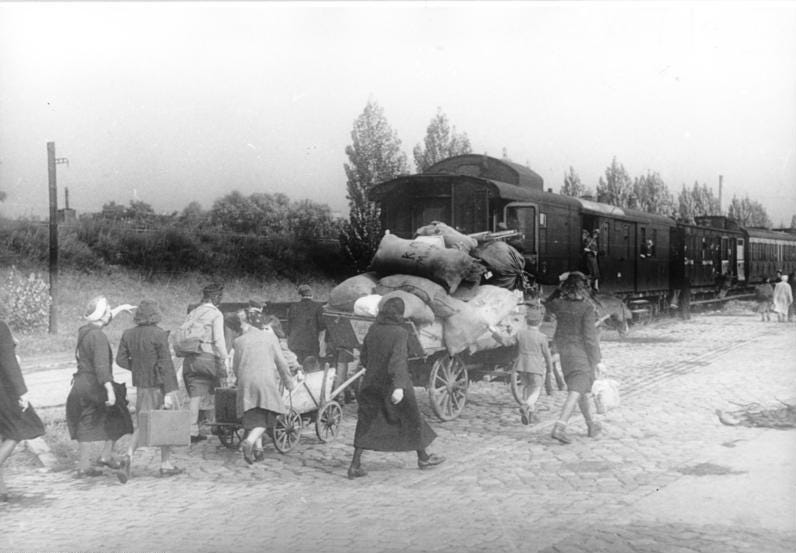
Because the measure in which the expulsions were carried out, was that violent (warning: the BBC documentary linked is extremely graphic and disturbing). These were not “ICE-style” deportations in which Hollywood celebrities and perennial university and coffee shop leftists virtue signal about, because the measures to enable the expulsions consisted of organized mob-lynchings of men, women, and children, the issuing of identification badges to signal whether individuals were German or not (akin to the forced Star of David badges), mass rapes, usage of Nazi concentration camps and methods to force internment and deportation to “proper Germany” via cattle wagons for an already starving population (reappropriation of Nazi deportation methods), with full and clear intentions in the destruction of the Prussians and Sudeten Germans.
The brutality of the expulsions was already visible before the 1945 Potsdam Declaration in the form of the East Prussia Campaign of 1944, when Red Army atrocities (such as the mass killings in Nemmersdorf and mass rape campaigns that Solzhenitsyn later described in his lesser-known book Prussian Nights) became routine and spontaneous. The Soviet Russian atrocities weren’t random bugs — they were products of years long of propaganda and selective instrumentalization of history and religion to cultivate a common mentality amongst the average Soviet conscript that the notion of “Why I want to kill every German” became mainstream within the Red Army, as well as a tool for Stalin to consolidate control and loyalty within a deeply fractured Soviet Union that was marred by famines, the Great Purge, and internal rivalry.
The pattern of Red Army (and later in Afghanistan, and as the Russian military in Chechnya, and later Ukraine) war criminality and willingness to commit crimes against humanity rest specifically upon a mixture of Orthodox theology concerning oikonomia (pastoral flexibility) and Marxist-Leninist propensity to commit violence in the name of paving the way for an utopian future or because Russia is the Katechon (restrainer of the Antichrist). Before the initiation of Operation Barbarossa, the Soviet Union had already committed numerous genocide via state-sanctioned instrumentalization of terror and extermination orders against Cossacks, in the Caucasus and Central Asia, and the weaponization of hunger which created the Holodomor and used to destroy the Tambov Rebellion, as well as class-based extermination campaigns, for Marx himself declared in the Manifesto that:
In short, the Communists everywhere support every revolutionary movement against the existing social and political order of things… They openly declare that their ends can be attained only by the forcible overthrow of all existing social conditions.
This is hardly the only passage in which the Manifesto dictated that violence is not only necessary but an absolute duty to bring about the revolution (and the communist utopia), and it is a line which is repeated by communists throughout the world. It is sufficient in the demonstration to how Protestant divorce of faith and works immediately mutates into consequentialism, and while Marx himself called faith as the “opium of the masses,” Marx was a product of Protestant thinking. He was born to a Jewish-turned-Protestant well-to-do family, studied in the premier Protestant-led institutions of Prussia, was influenced by Hegel, which in turn was influenced by Immanuel Kant.
It is the same theological substrate which produced the sacralized nation-state and “elected nations,” but this time it produced a form of internationalism which is also equally messianic like the French Cults of Reason and Supreme Being. The reason why, even however miniscule and oftentimes sentimentalist it may feel, Anglo-American Protestant still retain some sense of proportionality, even if diminished, is because if faith only requires you to believe and not perform works (not just merely in the participation of the sacraments) to be saved, then it is inherently hypocritical. At the end of the day, you still have to work towards the ultimate end goal, whether it is for the salvation of your soul or for an earthly utopia. But what has changed, however, is that you have assumed that you’re justified regardless of your actions, and therefore you’ve collapsed into nihilism via consequentialism. Everything is justifiable, even if certain actions are intrinsically evil. In other words, Marxist teleology is fundamentally comparable to Premillennial theology, where the Third Temple must be built to bring the Second Coming of Christ and the Tribulation, but here faith is the Party, and the Tribulation is the Revolution.
But how does this square neatly with the engineered revival of the Moscow Patriarchate in 1943 and the selective propagation of Russian Orthodoxy as propaganda? On paper, Orthodoxy shares the same seven sacraments as the Catholic Church, the same faith and works, and emphasis apostolic succession. But these are all de jure, not de facto. The problem with Orthodoxy and the criticism towards the ethnic nature of it was never merely confined to the Russian variant, especially with regards to recent Orthodox developments like the Volos Declaration. There’s a reason why the 1182 Massacre of the Latins is often downplayed or whitewashed/justified in the same lieu as how Islamist terrorists justify their acts of terrorism against innocent population via justifications, such as blaming “Latin arrogance,” despite the body count of the massacre standing at several thousand and involved the spontaneous and targeted murdering of innocents, including women and children.
The usage of “Latin arrogance” as a scapegoat for a coordinated massacre on thousands of innocents isn’t a bug either; it is a product of theological disagreements in which Protestants and the secular world gloss over or do not understand, but can be felt. Orthodoxy certainly does not have its own Calvin or Luther, but the intertwined nature between the state and the Church in the Orthodox world found continuity with the nascent Protestant world, starting at the 18th century with the Enlightenment and the mimicry of the Frederician “King as First Servant of the State.” Before the forced 1817 merger of Calvinist and Lutheran denominations in Prussia and the establishment of the Prussian king as the Summus Episcopus (Supreme Bishop) of the Prussian Union of Churches, the Byzantine Church was effectively a tool of the Byzantine Empire and had the support of the Byzantine Emperor to carry out the 1182 Massacre, and after the fall of the Constantinople, the national-branches of the Orthodox Church soon became tools of their own secular governments.
The frequency of intermarriages between Protestant and Orthodox monarchs isn’t a bug either. While Catholic monarchs have had Protestant spouses (such as the marriage of Marie of Prussia to Maximillian II of Bavaria), these were the exceptions, not the norm, towards the extent that there was a marriage bloc between the Oldenburg (and its cadet branches), the Hohenzollern (the Prussian/Franconian main branch), and the Romanov families. On top of that, when the-soon-to-be Nicholas II married Alix of Hesse (the later Alexandra Feodorovna), Alix initially resisted the conversion to Orthodoxy, but converted after his sister Ella (Elizabeth Feodorovna) told her that she didn’t have to abjure her Lutheran faith to be received into Orthodoxy. While there was certainly conflict between the Russian Church and the government over the questions of freedom of religion (because it allowed Orthodox adherents to convert to Evangelical Protestantism) during the time of Nicholas II, it did not overwrite the common ontology of Protestantism and Orthodoxy that are expressed in both theology, politics and sociology.
First of all, if Orthodoxy affirms the same faith and works as the Catholic Church, then how come did Orthodoxy produce theological justification for the Massacre of the Latins and whitewashing of the Bucha Massacre (against fellow Orthodox adherents)? The tension between faith and works in the Orthodox world is expressed via the Essence-Energies Distinction, the Orthodox oikonomia and symphonia which are central to Orthodox theology. The major difference between Catholic theology and Orthodox one is that of the nature of God, for Catholic theology argues in favor of Divine Simplicity, that is: God is all-knowing, accessible and knowable to those who cooperate with his Grace and seek him with a genuine heart. Essence-Energies Distinction, on the other hand, argues that God is unapproachable and beyond human categories, then he is fundamentally incomprehensible and can only be remembered as God, because if God is perfection incarnate, then there must be instructions rather than the fatalistic acceptance that “we live in a fallen world,” which becomes de facto double predestination.
The Essence-Energies Distinction therefore collapses under its own contradiction, because if the raison d’etre of preventing God from being “desacralized” via human concepts and definitions, then it becomes a definition in of itself. Whether over God or any other article, if you define it (or Him) by something it (Him) isn’t, then it is still a definition. A subtraction is different from an addition in mathematics, but they’re operations nonetheless. If God is not X, then He must be Y. One can argue that this was the predecessor of Immanuel Kant’s “we can’t know things in of themselves,” for Kant argues that we can’t know reality whilst stating a ontological claim that “we can’t know things in of itself,” so that’s a contradiction in of itself. If God is incomprehensible to the human mind, then what is the meaning of the incarnation in the form of Jesus Christ and the Word made Flesh? If the children of God cannot understand him, then is He still God and is humanity itself an accident?
Yet somehow, some way, we ought to go to church, we ought to blindly believe that God is with us (Gott mit uns, Matthew 1:23), and all we can do is remember His presence and His Word. If this isn’t a form of absolute legalism, then what is? This is the greatest irony in which Orthodoxy works: it often critiques the Catholic Church for “Latin legalism,” but it operates on its own system of legalism as discernment is systematically discouraged, then it negates the question of proportionality and agency (accountability). If oikonomia (pastoral discernment) cannot be discerned, then objectivity becomes merely a subjective matter and accountability dies for impunity under the guise of “communal warmth” or “national destiny.” Here, it’s a tension that specifically impacts the faith, for if we do not understand Him, then the “Holy Fire” concept is ultimately an abstract concept with millions of different interpretations.
This is where oikonomia finally meets the symphonia model. The frequent intermarriages between Protestant houses and the Romanovs aren’t theological errors, because on an ontological, political, and sociological level, both sides are the same. Yes, the differences between whether Christ instituted seven or two sacraments aren’t technicalities in theology, but they are on these specific three levels. Peter the Great’s abolition of the Moscow Patriarchate for the Holy Synod and the Ober-Procurator system is directly modelled after Protestant national churches in the Nordic countries and England. The Cross is there, but the Crucifix (Corpus Christi) is often not or downplayed, because since humanity killed God, then no population can consider itself as the elect, or can deicide be distanced via emphasizing the “unapproachable Light” because the Word has been made Flesh — it is a deliberate distancing from the works, both the need to atone for the sinful and the need to sanctify it by following God’s words and placing him at the center, not at a distance. But because God cannot be understood, but has promised redemption and salvation, then God is with whom?
To further reframe this, if God is killed by an earthly power (Pontius Pilate) with public support and spectacle, then it is incompatible with symphonia — the idea that the Church and the state should work in harmonious union. If sin cannot be properly categorized and actions cannot be discerned as whether sinful, then this operates de facto as another form of national predestination. It is no mistake that the Ober-Procurator System, which was designed with the help of and co-opted by Freemasons (which Freemasonry is seen as immoral by Orthodoxy) and based on Protestant state-church systems, the Massacre of the Latins, and the deliberate selective institutionalization of Orthodoxy by an atheist tyrant are enabled by that same tension between faith and works. Where Protestant and Orthodox national predestination diverge from each other is the former is idealist, while the latter is materialist because it emphasizes the participation in the “Divine Mysteries” and sacraments whilst somehow, some way, the nation is chosen by God and His works will materialize without comprehension. Protestantism, on the other hand, assumes that because God has already selected those who are damned and those who are saved, therefore their actions do not matter.
But since symphonia is the ideal in which the Orthodox strives for, without a God that is understandable, then, it collapses into blind faith in the state. In the case of Russia, if the “Holy Rus’” is the Katechon (the restrainer of the Antichrist), then it cannot have witnessed a violent transition between three regimes, from the Tsarist Empire, to the atheistic Soviet Union, and a politically fractured Russia held together by corruption via patronage. If the anointing of Nicholas II was supposed to grant him all of the wisdom needed to run a politically unstable, economically poor, and underdeveloped empire, then it shouldn’t have collapsed with the Provisional Government and then the Bolsheviks that would “martyr” him (however horrific the Ekaterinburg murders were). If the Soviet Union was part of that “Holy Rus’,” then it shouldn’t have persecuted Orthodox adherents, called faith “opium of the masses,” and partially institutionalize the Moscow Patriarchate to sanctify the same Stalin who murdered around 20 million (that kept Orthodox adherents under, albeit lighter, persecution post-WWII). If modern Russia is the “Holy Rus’,” then it cannot have the highest rates of abortion, alcoholism, HIV/AIDS, drug abuse, and domestic violence rates in Europe, or require openly neo-Nazi mercenary groups (Rusich, Espanola, and remnants of Wagner) or deceiving foreigners to join the “ZOV.”
The mechanism in which an Orthodox make God “transcendent” is no less similar than how a Marxist argue that workers are “oppressed” and application of terms like “class traitors,” for it argues the man and the worker are incapable of comprehending reality, but makes an ontological sleight-of-hand to claim truth to knowledge (whether “scientific” or divine). In the eyes of the average man, he will never be able to reconcile the claim of divine sanctioning (or utopia) when the reality contradicts it (Massacre of the Latins, Nemmersdorf, Bucha, or breadlines). Thus, the default mechanism to protect this “elect” status comes in the form of denialism, whether via the traditional blatant denialism (such as Russia’s retroactive denial of the Katyn massacre), self-projection or whataboutism.
So how do these all tie back to the expulsions of Potsdam, and why Potsdam was a genocide? The intent and the execution of the expulsions have been documented, so the basis for a classification as an ethnic cleansing is often used, because the targets were Prussian and Sudeten German populations, where are often seen as a subset of Germans. This is the most common position in academic discourse, though there have been arguments that the expulsions constituted genocide. When the Allied Control Council decreed Law No. 46, which declared:
“The Prussian State which from early days has been a bearer of militarism and reaction in Germany has de facto ceased to exist.”
The first problem with this notion of Prussia being a “forebearer of militarism and reaction in Germany” is that it is an “otherization” based upon a shared common ontology operated by Prussia, the Western Allies and the USSR, with the only difference being which nation (or notion, as in communist internationalism) is predestined to succeed. Aside from the fact that pre- and post-19th century, the countries (via their predecessor states) dictating the Law No. 46 are also guilty for their militarism (colonialism, the violent Soviet campaign to retain Imperial Russian territory during and after the Russian Civil War), the ontology of Prussia itself is “progressive,” not “reactionary.” The common religious links that existed between Prussia and the Protestant Western world, the shared teleological pattern Prussia and Russia. There’s no need to revisit the popularity of eugenics, Lysenkoism, class-based extermination, and their popularity in the Western world, post-1918 “German/Prussian” radicals, and the Soviets, and how these conflict with traditional Catholic teaching that Protestant and Soviet sentiment condemned as either “parochial” or “reactionary.”
So there in lies a problem: Prussia, far from being an incomprehensible “reactionary” evil, shared and acted in ways that mirrored ideological trends shared by the non-Catholic powers throughout the times. The decades that eventually led to the unification of Germany in 1871 witnessed major conflicts between the German states themselves, France, and Austria (which itself is Germanic) that is reminiscent of during and post-Civil War Russia violently retaining whatever loss territories, though without the mass terror in which the Bolsheviks utilized. When Stalin commissioned the Soviet propaganda machine to honor pre-revolutionary Russia’s military figures like Alexander Nevsky (against the Teutonic Order), it wasn’t done to rehabilitate the Romanovs or the Tsarist era in an abstract manner, but to tap into the only thing that could have possibly bind the fragmented Russian masses together after starvation and terror in the name of abstract, Protestant-originated Marxism: the Orthodox faith. In fact, the Russian name for Orthodoxy means “faith of the Slavs.” In other words, every side was using their own version of Gott mit uns to justify whatever depravity they committed themselves to. These need not to be further covered.
What is notable, however, is the conflict between the German states before 1871 and the regional tensions that remained after the unification of Germany. When the expellees from Silesia, Pomerania, West Prussia, and East Prussia arrived into “proper Germany,” it wasn’t a smooth integration. While the stories of what happened to the expellees after their arrival have been forgotten, aside from the establishment of the BdV (Federation of Expellees) and short-lived parties like the GE/BHE (Bloc of Expellees and Those Deprived of Rights), the memory of the day-to-day experiences for the expellees during their first decade in the nascent Federal Republic (West Germany) wasn’t short of hardship and discrimination. The hardships through the treacherous journey from the East to the West, the real dangers of lynchings and rape, the brutal treatment of them that mirrored Nazi treatment of “undesirables” in many aspects (except systematic, industrialized extermination of death camps like Auschwitz-Birkenau), and entering a similarly starved and bombed-out “proper Germany.”
But the discrimination they faced is something almost untold in historiography of either the Western Allies or that of post-1945 Germany itself. When the expellees entered the Catholic West (except Lower Saxony, Schleswig-Holstein and Hesse), this resulted in a fierce clash between the natives and the expellees, because these regions carried the memory of the Kulturkampf (Bismarck’s suppression of the Catholic Church), lost autonomy or independence (especially in Bavaria), and exposure to an entirely different societal structure and norms. The latter part isn’t an abstract difference either, as Konrad Adenauer (the Federal Republic’s first premier) privately remarked that “Asia begins at the Elbe,” he isn’t engaging in a philosophical debate within his inner circle or his cabinet, but expressing a common position which were expressed by the Rhenish, Bavarians, Württemburgers, and to some extent, Westphalians.
That’s because the Prussians themselves (excluding the populations of Westphalia and the Rhineland, which came under Prussian control after the dissolution of the Holy Roman Empire) are not fully “German” or “Teutonic” either. The term “German,” and the word “Germany” (or the French “Allemagne” or Spanish “Alemania”) refers specifically to the Alemanni, a confederation of Germanic tribes that spanned from the southwest (including Austria) to Alsace-Lorraine that were exposed to the Roman Empire’s influence and rule, which didn’t penetrate up into the Northeast of Europe (such as the Baltic Coast), but confined to Western Europe, the British Isles, and to some extent, the Southeast of Europe. When the Roman Empire split into two, the Western Roman Empire remained a more contractual, guild-based, and lawful society than the more personalistic, patronage-based, and centralized Eastern Roman Empire (the Byzantine Empire).
In other words, the term “German” doesn’t refer to the East of the Elbe, for there lies an entirely different society in both cultural and even racial terms, and is referred in Slavic languages as “Niemcy” (the term itself descending from a proto-Slavic word meaning “those who don’t speak our language”). This isn’t to say that there weren’t any migration from West of the Elbe into the East (the Hohenzollerns originated in Hechingen, Württemburg, and the Prussian branch originally reigned in Franconia and Neuchatel, Switzerland), but those who did often assimilated into what would become Brandenburg-Prussian society, the so-called “Sandbox of the Holy Roman Empire.” It is not a “quirk” that many East-Elbe towns often feature names like Potsdam, Görlitz, Danzig, or Tilsit, compared to Dortmund, München (Munich), Stuttgart, or Köln (Cologne), and even individual names that often ends with -itz, -ke, -ow, -ki. Yes, there were many whose names carried the typical German ones like Schmidt or Schumacher (shoemaker) and are based on old professions, but the numerous and frequencies of the -itz, -ke, -ow, -ki endings aren’t random; they are linguistic fossils of the Slavic Wends, Polabians, Warmians, Masurians, and Old Prussians that inhabited East of the Elbe and made up the backbone of the demographic.
This isn’t just an observation of a “minority,” but the sociology and history of Prussia itself. When Prussia started out as the Terra Mariana under the Teutonic Order to safeguard travels for Christians, defend against the pagan Balts (the Old Prussians), and Christianize them (however brutal the process was), the Teutons did intermarry with the local populations, as did those who moved into Brandenburg with the Wend and Polabian populations. In modern studies, regions that still remained part of Germany, such as Saxony and West Brandenburg, up to 40% of the population in certain areas carried Slavic DNA (without accounting for the reality the expellees and their descendants make up 20% of the German population). The dialects of these populations, such as Silesian-German, Low Prussian (Niederpreußisch), or Marchian (Brandenburgish/Märkisch) carry numerous Slavic-originated loanwords and pronunciations that sounded rougher and more guttural than the softer dialects of the West.
The social order East of the Elbe is also markedly different from the West too. The system in which the Junkers operated under didn’t differ from the Polish szlachta or Russian boyars, and sustained post-serfdom systems of patronage, rent-seeking and corruption that are still visible in post-East German lands, Poland, Russia, and broader Eastern Europe. This wasn’t the original modus operandi of the Junkers, but one that corresponded with the Protestant Reformation and the subsequent secularization of Church lands that allowed them to expand and impose a system of punitive rent-seeking and abolition of rights such as appeals to higher courts, sales of crops (and processed goods, such as beer), and imposition of punitive duties as part of the rent paid to the lord — which were also done for the sake of filling the state coffers. This differed significantly from the post-11th Century Western Europe (and West-Elbe lands), which only imposed rents via cash or some form of labor, and was only partially reformed when Frederick the Great imposed the Allgemeines Landrecht (the Prussian Civil Law) and later abolition after 1848.
While the average West German certainly did not fully understand or aware the history of Prussia, the cultural substrate and difference were certainly visible in the form of dialect, different religion, and cultural norms. There were already existing resentment towards Prussia and the Prussians over loss of independence or autonomy, the memory of the Kulturkampf, and the Catholic/Protestant divide, but post-WWII hardships and forced sharing of homes (the Zwangseinquartierung imposed by the Western Allies, and the later Lastenausgleichgesetz) contributed to an explosion in anti-Prussian sentiment. Western German regions, inflected by Catholicism, often opposed the Nazis and voter turnover for the Nazis in these regions often only hit 40% (especially in mixed areas), compared to Protestant areas that stood East of the Elbe (which saw a turnout at 60%). It was not uncommon to hear older terms like “Saupreiß” (Pig Prussian) used, but also more racialized ones like “dreckige Pollacke” (dirty Polacks) applied to the expellees, which contributed to demands not only for lost homelands but also equal treatment from expellee organizations.
This is what was often overlooked: while the expellee organizations themselves often attract outside scrutiny over revanchism, the original charter of the Federation of Expellees also included:
2. Just and reasonable distribution of the burdens of the last war among the en-tire German people and an honest application of this principle;
3. Reasonable integration of all professional groups of expellees into the life of the German people;
Aside from the emergence of brief but powerful expellee-driven organizations and parties like the GE/BHE, the expellees themselves were initially strong supporters of the SPD and its socialist program. They supported the “just and reasonable distribution of the burdens of the last war” in the form of the Lastenausgleichgesetz (Equalization of War Burdens Law, which was a redistribution program to prevent potential political radicalization or turnover to the SPD) as much as the demand for the old borders back, which was the early post-war position the SPD held under Kurt Schumacher, and “reasonable integration” of expellee professionals who were often assigned menial jobs after the expulsions. It didn’t matter that these people were “German,” because they weren’t in that “Allemagne” sense; the term “Deutsch” is a neutral term originating since the 14th Century, but it did not paper over the real differences between “Allemagne” and “Niemcy.”
In other words, now we know that the Prussians are an ethnically and culturally distinct people (Poland also expelled numerous ethnic Silesians, both to Germany and as forced labor to the USSR, Warmians and Masurians post-1945), the methods of the expulsions, and the Allied intention to destroy, in whole or part, a population, the only honest classification is that of genocide. A genocide need not to be of the scale of the Holocaust or the proportion of the Khmer Rouge, but it simply has to meet these definitions, because the expulsions themselves were mass devastation (far worse than Stalin’s deportation of the Chechens into Central Asia and of the same scale as the Purges) inflicted upon a culturally and ethnically unique population who was caricatured by the post-war consensus. The Soviets deliberately carried out the brutality alongside Soviet-aligned Polish elements (which weren’t an insignificant faction, contra post-war and Cold War narratives) to inflame German revanchist sentiment and force the Poles into a situation where they must depend on Soviet “protection.” The end of WWII was not that of a triumph of good against evil, but a reaffirmation of that similar kind of evil, now with better PR.
III. The Königsberg Boomerang
It has been 80 years since the expulsions and the Oder-Neiße as the official demarcation of the Polish-German border, and certainly the expellee question itself had faded away significantly. For the descendants of the expellees, the question over Breslau, Danzig, and Königsberg (though the latter is more complicated, as shall be explained later) is mostly sentimental — a sort of “never again” and a Recht auf Heimat (Right to Homeland) that mainly involves the prevention of another expulsions and revisiting lost homelands after the eastward expansion of the EU. Whether or not one thinks of Breslau as purely German, Polish, or an admixture of both belongs to his opinion, but not many would raise the question on adjusting what has been the modus vivendi of the past 80 years.
But the question that we’re dealing with isn’t just the genocide of the Prussians, but the same ontology that enabled strands of horrors which enabled not only the expulsions, the Holocaust, or the Great Terror, but many of the moral and societal travesties that happened yesterday and are happening today. It is not about whether or not should the Ostgebiete be returned to Germany, but what our current “moral” codes can justify when we assume that we’re automatically justified and “can repent or think about it later” (for the more sentimental and thoughtful individuals still operating on that post-Reformation/Orthodox/Romanticist thinking). We may have forgotten about the fate of the expellees, adopt a generic but fatalistic “never again” line, or can never comprehend the evil; but if we wish for “never again” to be true, then we must be objective and unflinching, not just sentimental. It isn’t just about massacres or atrocities that grab the headlines, but the day-to-day conduct of states and political factions and movements which enable a lack of moral accountability; this isn’t just about the West, but everyone, for they all have internalized the post-1945 order.
That global order is nothing more than legalism with a thick moralist mask — the United Nations had to impose Article 107 in the Charter of the UN, which is an immunity clause for Allied atrocities under legalese by stipulating that:
“Nothing in the present Charter shall invalidate (emphasis mine) or preclude action, in relation to any state which during the Second World War has been an enemy of any signatory to the present Charter, taken or authorized as a result of that war by the Governments having responsibility for such action. (emphasis also mine)”
In other words, it basically means “genocide, criminality and whatever atrocities are fine so long as we do it for the sake of liberal-democratic internationalism, communist utopianism, the new world order, etc.” One might as well argue that had Nazi Germany and the Axis won WWII, they would have written the same thing to impose their own horrific order. According to the UN, the failure to prevent Srebrenica, the Oil-for-Food scandal, the Rwandan Genocide, and other numerous instances of preventable moral depravity that happened under the watch of the UN can’t be blamed on it. Much like the shaky and brittle post-18th Century global order, the UN only adds a podium and a talking shop in New York, whilst everyone privately take swipes at it, politicians run unsustainable deficits and print money, or authorize repression and commit crimes (including crimes against humanity) with impunity.
This is why whataboutism is such a convincing argument on a national and international scale, because if the other side does it, then why shouldn’t we not do it — it makes the moral costs of the decision insignificant in the psychological sense. But it does, and will never erase or even reduce the costs. Morality isn’t sentimentality, and you cannot divorce faith from works, because action is purposeful — you cannot use the Kantian sleight-of-hand or the Orthodox incomprehensibility to escape from consequences. Faith is neither irrational or incomprehensible, and mysticism isn’t a get-out-of-jail-free card when the tension between faith and works are noticeable. If your neighbors cheat on the local store by hiding produce instead of letting the cashier account for it, what stops you from such a decision other than your own discretion? When the community does so, whether via cheating the store or outright looting it, eventually the store will impose higher prices to fund security measures, the police will become more present and burdensome, and/or the store itself closes.
Since we’ve already mentioned Bucha, the war in Ukraine itself is not short of the demonstration of a failure of a society that thinks itself as anointed by God but can’t even comprehend (and follow) God’s Laws. What geopolitical analysts and strategists often talk about are abstractions, such as “balance of power” or “strategic interest,” they assume every actor would, out of self-preservation, avoid war, hence the creation of doctrines like Mutually Assured Destruction and how it would bring perpetual peace to avoid MAD, war still continues in the form of proxy war, as in Ukraine right now, and places like Afghanistan, the Middle East, Southeast Asia, and Africa. They assume that actors are inherently rational, and therefore they won’t commit themselves to catastrophe to secure an abstract geopolitical goal. When Clausewitz stated that war is simply a “continuation of politics by other means,” surely war itself can be conducted by other means — since state power is ultimately top-down and all states operate on a secularized version that they’re the “agent of God” on earth, to paraphrase Hegel, then it depends on how they think “progress” occurs.
We do not need to rehash the theological foundations that enable the consequentialist and expansionist mindset (or as in regular politicized speech, victor’s justice) which the secular-Protestant West and Orthodox Russia share, even if the mechanisms which lead them to the same endpoint are different. We don’t need to mention the atrocities, for they have been covered; the intention of this section is about how those same mechanisms always place a cost on the same collective and the same regime that enable them. Bucha and other Russian atrocities in Ukraine have been extensively documented and need not to be further dissected, but the irony of the so-called “de-Nazifying ZOV” using neo-Nazis and can’t “liberate” lands beyond Odessa are to be noted. Even if many Western strategists lose sleep over whether tomorrow the front holds well for Ukraine, the reality is that the invasion of Ukraine has been a strategic disaster for Russia and the Russian messianic claim, for the invasion itself has exposed major gaps in the Russian spiritual-political identity it claims.
The reality is rather simple. The Katechon cannot be that of a nation-state known for an abortion rate that dwarfs the European average, known for staggering drug and alcohol abuse, HIV/AIDS rates that stand ten times above the average European rate, known for requiring the release of hardened criminals (including murderers, rapists, and pedophiles) into the frontline to serve the nation’s and the criminals’ needs, known for funding and sponsoring ethnic tribalism via Soviet transplants in the Baltic States, and known for nuclear saber-rattling on stolen land which was once known as Königsberg, whilst letting China charge extortionate rates on goods and getting leases on territory in which China now labels as “Haishenwai” (the Chinese name for Vladivostok) and watching North Koreans (militant Stalinist atheists) sing a Russian propaganda song about God with Russia (Ya Russkiy). This isn’t to say that the Ukrainian state is a hero (it certainly isn’t, considering the corruption there and entities like the Azov Brigade) or Ukrainian society is without flaw (low social trust, alcoholism, etc.).
Of course, the average Russian can shake his head, produce the same excuses of “Western Russophobia” and list a lot of problems about the West (which they do exist, and they aren’t as insignificant as Western liberals and progressives make them out to be), but at the heart of it stands the same excuse as the Western leftist: “What about our grand vision?” The calvary isn’t coming when 1.5 million Russians have found themselves as casualties over a frontline that hasn’t faced any significant shift for the last three years. The calvary isn’t coming when 8% of the GDP is spent on war, and certainly the percentage would be far higher when accounted for subsidies spent to maintain outdated and uncompetitive mono-industrial extractive towns like Norilsk, whilst cost-of-living pains are heightened to maintain a fragile patronage/oligarchic system and a disastrous war. The calvary isn’t coming when pro-Kremlin celebrities complain about a “wall” between Putin and ordinary Russians, however staged the campaign was, and certainly not when the average Russian Orthodox apologist has to use a VPN (which is increasingly cracked down upon) to connect to YouTube (which is blocked in Russia) to advertise Orthodoxy when most Russians don’t even believe in God.
To translate this into theological terms, national predestination and the “Holy Rus” idea are blasphemy against the Holy Spirit because it denies the moral severity and the consequences of that immorality to project an image of election by God. This is moral and ontological bankruptcy in the starkest term possible: an identity that must sustain on the romantic narrative of raison d’etre of the Katechon of the “Holy Rus” that can act with impunity, because God is fundamentally unapproachable, but somehow we must undergo a process of Theosis (deification) that is incomprehensible, and somehow we understand that symphonia is the ideal model. This isn’t a one-time incident, but one that has spanned from the Tsarist-era, then Soviet totalitarianism (when convenient during WWII, the Mitrokhin Archives’ details on collaborationism with the KGB), and now modern Russia. It is not an indictment of the average believer, for they may not know of the severity or they, overtly or covertly, reject the Kremlin and the Patriarch’s (who has over $1 billion in wealth and is rumored to be cohabiting with a woman) actions, but an indictment of the ideologists who continue to be unrepentant. The Russian or pro-Russia apologist who performs whataboutism, blames Russia’s ills on “the Jews,” “traitors,” or “corruption” (ironic, considering the tripod of Tsarist, Soviet, and military-industrial complex is held by personal loyalty to Putin), or claim “Russophobia” is only a further confirmation of it — because whataboutism goes both ways.
This is why the same Kremlin can issue a ban on Telegram, but still uses it alongside the military for communication over its own state-supported Max platform. This is why Russian politics is composed of Tsarist LARPers, Soviet nostalgists, and military-industrial complex kleptocrats under a shaky patronage system by Putin, with neo-Nazis (or adjacent, as in the case of the now-absorbed Wagner) doing a disproportionate amount of work in the invasion of Ukraine, and propagandists openly comparing Putin to Hitler in a positive way (not over the Holocaust or Operation Barbarossa, but the myth of the capable strongman Hitler that carried Germany out of the Great Depression by masking unemployment with massive state spendings) despite laws against rehabilitating Nazism and economic contraction once war spendings cannot cover deeper issues. This is why ideological Russians still claim onto the “Holy Rus” myth, despite the insurmountable evidence of Russian exhaustion in domestic affairs, and a society marked with low trust (both towards themselves and institutions, symbolized by apps like Telegram). Meanwhile, the South Caucasus is lost to American influence, the Gulf is encouraging the U.S. to get tougher on Iran, China is solidifying de facto control of the Russian Far East, and Ukraine continues to be a financial blackhole and meatgrinder. Russia cannot force through actual nuclear deployment other than “lowering of standards” bluff, because that would trigger MAD and destroy the “Third Rome.”
The only question left is this: if Russia operates with a similar ontology as the West, then why is the West more successful in terms of economic output and social cohesion (though it has declined significantly)? The difference between the West and Russia (and consequentially, the East) is that, even after the Reformation, the West still retained a diminished inheritance of the methods of the Catholic monasteries, the Carolingian rule of law, and the separation of powers (the Investiture Controversy and the lingering influence of the Two Swords doctrine). The monasteries of the Catholic world was both of Prayer and Labor, to paraphrase the Benedictines’ motto, and they were pioneers of crop rotation, beer and liquor brewing (which was critical at the time, since beer and liquor were often substitutes for water when there wasn’t a clean water source), cheesemaking and charcuterie curing in a world without modern refrigeration, and scriptorium that preserved Ancient Greek and Roman works and functioned as printing houses before the invention of the printing press in the 15th century.
Even after the Reformation took its course, before the emergence of Protestant-led institutions like Oxford (teachings there began as early as 1096, and monasteries were established there at least 200 years before), Cambridge, and the American Ivy League Universities around the 18th century, the nascent Protestant world often sent students of both natural sciences and theology to Bologna, Padua, Louvain, and other Catholic institutions for learning, and some even stayed and became converts, clergymen, or scientists. Niels Steensen (Nicolas Steno) was a Danish Lutheran convert to Catholicism and a pioneer of geology and anatomy, and he was among the many who were clergy-scientists, convert or cradle. Even though Steensen studied at the University of Copenhagen, the university was founded in 1479, which was several decades before the Reformation. That’s because the idea of the university itself originated in medieval times — long before the Reformation took its course — and even after it, the Church produced the Gregorian Calendar (which is the current calendar we’re using and was only adopted by Protestant countries after the 18th century, roughly 100 years after its promulgation), Fr. Georges Lemaitre (the father of the Big Bang theory), and other notable scientists, clergy or laymen. This isn’t to say that the Protestant world didn’t produce any scientists, but the method of studying natural sciences were unintentionally preserved, especially after the 19th century after the traditional Scholastic institutions were eroded and scarred by the French Revolution, Napoleonic Wars, and nationalist-anticlerical movements in France and Italy (the Risorgimento).
When the first British colonists came to America, especially those in New England, they were Puritans (the Yankees), and they were fleeing from what they saw as a heretical Church of England, and the Puritans were known for their industriousness and restraint — even though there existed 200 years of Reformation history at the time, it didn’t fully erode the inheritance of Cardinal Virtues and that beginning constitute effectively as works against the British monarchy. The way Catholic-Protestant differentiate themselves between works and faith is often presented via the question on how many sacraments that exist (at least in the modern ecumenical sense) often blurs the Thomist understanding that works don’t just constitute participation in the sacraments but every action taken that we’ve articulated in the previous section. It was that inheritance that led to the establishment of Harvard, Yale, MIT, and other high-level education institutions, the education of former slaves and their children during the Reconstruction era, and the industriousness of the North, compared to the South for the first 200 years of America’s existence. The South, on the other hand, was populated by the Ulster-Scots, which were descendants of royal/state-sponsored colonists in Northern Ireland, combined with a cultural substrate prone to impunity and entitlement, produced a wholly different society and were often mocked by the Yankees (the racially derogatory term “cracker” was originally applied to Southern Whites by the Yankees).
Nevertheless, that same theological baggage of the Reformation, sola fide, and Calvinist Predestination gave birth to the same kind of demands for political impunity and national predestination similar to the Old World which American identity claim to distance itself from. Even when Woodrow Wilson voiced his opposition to Lloyd George and Georges Clemenceau over the punitive terms imposed on Germany, the League of Nations concept and American involvement in remodelling the world order originated from the same teleological vision, but with America at the center for its status as the “Shining City on the Hill,” which is a Puritan idea. Of course, most of the Senators who voted against joining the League of Nations operated with the same teleological vision of national predestination. But it is the same religious substrate that mainstreamed eugenics, implemented the Prohibition, and played a vital role in the 1960s Counterculture and longstanding pro-communist currents — these aren’t accidents, but observable. The Yankees were Puritans who outlawed celebrating Christmas and initiated the Salem Witch Trials, now Congregationalism mostly consists of very progressive denominations. The Episcopal Church, while less radically Protestant than Congregationalism and Presbyterianism, was the first Anglican denomination to ordinate women and affirm gay marriage.
It is the same tension between the visible and tangible works and the faith that was supposed to lead us to the right thing, and when we assume that we’re always right, Gott mit uns, or we’re part of the elected (or not), then the kernel of truth in inconvenient narratives must be cancelled too. Of course, the “Shining City on the Hill” concept has long been secularized, but it still plays a vital role in the eschatology of the American public, whether it was Jane Fonda’s infamous AA battery photo and her “small-c” (communist) LARP for a regimes and ideologies that murdered over 4 million Indochinese, or Jon Voight’s genuine regret over endorsing the mindless anti-colonial craze that midwifed monstrous and genocidal regimes that later turned him into supporting endless neoconservative foreign interventionism, they’re the symptoms of the ontological incoherence. When Donald Trump ascended to the White House in 2017, this was perhaps the start to a uniquely violent rupture — it was unusual in that sense that the American public panicked beyond comprehension, leftist and large numbers of neoconservative pundits decried it as the death of democracy, and increasingly violent leftist rhetoric and comparisons of Trump to Nazism are unmistakably deranged.
But there’s a rationale behind this: the narrative that was fed to the American (and, by extension, Western) public has always been that after the fall of the Berlin Wall, it was only a matter of time until the secular-Protestant-inflected liberal democracy spreads across the globe, with every nationality yearning for Western-style rule as the final episode of history. But that same year in which the Berlin Wall fell (1989) was preceded months prior by the Tiananmen Square Massacre, then 2008 came along and induced a massive financial crash, and, finally, 2017, with Trump ascending to the White House and the way in which Trump did. Trump promised to pull out of Afghanistan and Iraq and deportation campaigns, both of which Obama promised (and was called “deporter-in-chief” for the latter), but the usage of profanity and rhetorical crudeness is, for the secular-Protestant Whig dogmatist, a profanation of the “Shining City on the Hill.” Trump, by all definition, is a believer in that same teleology, but he is unintentionally the uncomfortable mirror that managed to split the neoconservative movement into either selectively backing him or ally with Democrats (even if it means selectively supporting abortion on demand for active servicewomen).
This is why the Lincoln Project and their defense of Antifa as equal to soldiers on D-Day happened, alongside the Democrats’ rhetorical shift from being patriotic (while not unabashedly pro-U.S. like Republicans) to mainstreaming anti-American sentiments in the U.S., openly inciting and covertly assisting riots, assassination attempts, such as the failed attempts on Steve Scalise, Donald Trump, etc. and the murder of Charlie Kirk, and clear support for Islamic terrorism with Hamas apologia and open defense of 9/11. Make no mistake, the increasingly violent leftist rhetoric and action aren’t just mere political radicalization, but religious in of itself. The comparison of Trump to Nazism isn’t just mere paranoia, but a mimicry of the Potsdam Declaration’s “othering” of Prussians and Germans as an incomprehensible evil that must be destroyed at all cost. All of the left’s self-projected secular image is ontological incoherence that must downplay realities like how labor unions and suffragettes were at the forefront of the eugenics campaign during the Progressive Era, how the rhetoric of separating the Church and state was originally an anti-Catholic campaign, and current call for violence against those exposing immigrant fraud.
This is why the profanation of the “Shining City on the Hill” is so toxic to American liberal/leftists and neoconservatives. The post-1945/1989 order was supposed to be a triumph of liberal democracy, multilateralism, and multiculturalism, with America being the vessel of the “scientific” or divine order. Of course, there exist other Republican politicians and conservative pundits who are more critical of these components, but desecration of the “Holy Nation” is the unforgivable sin in the eyes of the believer in national predestination. If the U.S. was supposed to be the vessel or the main driver of liberal democracy, multilateralism, and multiculturalism, and you have an upstart, crude politician enter the most powerful position in the world and critiques leftist position with crudeness, then America isn’t a “Shining City on the Hill.” This is why the Democrats are willing to facilitate and cover for the most anti-American, pro-jihadist and pro-communist movements and entities in the U.S., whether in the form of the “Summer of Love” in 2020, encouragement of assassinations and violence via agitation (calling certain members of the right “fascist,” “neo-Nazi,” etc.) or calling half of the American population as “basket of deplorables” or other similar terms.
This isn’t a unique phenomenon in American history, because America itself shares the same religious ontology as the Old World and Russia (whether Tsarist, communist, or modern) and sees itself as a distinct entity with its own religious mission and identity as different from the Old World, and has multiple radical socio-political swings enabled by the “Shining City on the Hill” status and that tension between faith (the ideal result) and the works (the actual deeds themselves). If WWII was fought to defeat a racially genocidal regime by an inherently good nation, then it cannot square with Jim Crow and the cultural tensions that enabled it. It is a consistent application of a metaphysically and ontologically incoherent social-religious doctrine that conveniently ignores the reality that the North engaged in scorched earth tactics that horrified European observers, enacted a disenfranchisement of Southern Whites that helped birth Jim Crow and the KKK, and the North’s propagation of eugenics in the U.S. and its own pre-Civil War segregationist tendencies (such as Oregon’s original 1859 constitution explicitly forbidding Blacks from settling in the state).
This brings us back to WWII and the narrative that it was fought over a genocide. We’ve already noted pre-war cynicism, the original pure realpolitik concern over Danzig, Sudetenland, and Poland, and the retroactive application of the knowledge of the Holocaust to justify or whitewash Allied crimes against humanity and cover up pre-WWII Allied eugenics craze. The reason why the Vatican’s pivotal role in exposing the Holocaust, Pius XII and many clergymen’s (such as Mgr. Hugh O’Flaherty or the Dutch bishops) facilitation of Jewish escapes or hideouts in convents, monasteries, and Castel Gandolfo (a papal residential palace in Northern Italy) had to be downplayed is simple — it is Allied self-projection to shield their own involvement in inspiring the same Nazi völkisch ideology and their own racialist and eugenics deeds pre-WWII, and Soviet enabling of German rearmament and the minimization of the Soviet system of industrialized killing in the form of Gulags, extermination orders, weaponization of hunger, and the purges. Even during WWII and with the knowledge of the Holocaust known after 1942, many Allied intellectuals flirted with the mass destruction of the German population (Soviet indoctrination campaigns mentioned above and the Morgenthau Plan) and even outright extermination in itself (though this is relatively fringe, it did attract sizeable followings).
This is why Operation Seat 12 (the KGB slander campaign against the dead Pius XII) existed, because without the WWII mythology and convenient self-projection, the entirety of the post-1945 global order is nothing but a farce. Without the usage of 13 million genocide victims as a blank cheque for justifying moral hubris and crimes against humanity disguised as a noble project, then it makes the much mythologized and otherized Prussian ontology as similar to the British, American, Russian, post-1789 French, Asian and African ontologies, and how they enabled “humanitarian” (or “decolonial”) atrocities, the raison d’etre and even raison d’etat for post-1945 governments cease to exist as they are. There is nothing left to return to, because the ontologies have firmly clashed with reality and approaching exhaustion, the eschatologies of the post-Reformation/Enlightenment West and Russia (and the broader Eastern world) have hit a hard limit and exposed the internal contradictions of systems that no longer have the works (or capital, to use economic terminology) that align with the faith but instead clashes against it. Whataboutism will no longer work in this current state, because there’s nothing to fall back onto — exhausted populations, domestic troubles, and foreign policy difficulties. To use Austrian School economics terminology, the populations have finally consumed the social capital, and they cannot replace it.
This is why the entire world talks about ignoring debt and asking does debt matter anymore whilst having racked up $353 trillion in debt and dealing with massive malinvestments. This is why leftists and neoconservatives still think Trump isn’t being hard enough on Russia, despite this is the same Trump who supplied Ukraine with Javelins during his first term (something Obama opposed), is now waging war against Iran, Russia’s last ally in the Middle East, with encouragement from the Gulf states to get even tougher, after swaying Armenia and Azerbaijan from Russia’s orbit, and is still supplying Ukraine with weapons. This is why some Russians still double down on chest-thumping, despite visible exhaustion in Ukraine and the homefront, and collapse in Mali. These are all classic stories of unaccountability towards oneself, they’re on a cross-civilizational level and these examples are a very small portion of that lack of accountability, and the premiums are compounding.
The future ahead isn’t bright either. In many ways, it is a redux of the 1930s in terms of polarization and continued doubling down on narratives of distinctive chosen-ness. The left is increasingly rabid and will revert back to its most deranged form, the right is extremely fragmented and operates on the same top-down romanticism that enables the left and pure nostalgia, multiculturalist advocates have to scream “fascism” or “racism” when people point out real and significant problems of immigrant criminality, lack of integration, a greater cultural baseline for supporting authoritarianism and corruption (patronage and parallel societies), and many libertarians think they can rebuild a free market society in a world where people blatantly disregard property rights by simply cutting taxes, limit the government, and cut the deficit. The world is now increasingly defining itself as it is not to create some psychological comfort in having to see the similarity with the Other which we do not want to see.
Whether or not this brings about the restoration of Königsberg is uncertain. Similarly, whether one can kick out the Russian military out of the Donbass and wholly neutralize the mullahs in Iran are unknown, because the end result arrives earlier and later than we prefer. What we can confidently say is this: the grave of Russia will begin in Königsberg; not of another “clean sweep” but slow and painful strangulation (or perhaps with both). What we can confidently say is this: a high-trust, free market, and orderly society isn’t built on “good governance” from above or abstract romantic destiny, it must be built with hard work and consistent application of clear, just, and unbending rules. Trump might have stated some uncomfortable facts in, perhaps, a necessarily vulgar tone, but he isn’t the calvary when the deficit continues to mount under his tenure. Westminster and the Churchill family might have destroyed Prussia and millions of livelihoods by deliberation, but Westminster, D.C., the Kremlin have committed themselves to a long-term destruction of the world to remake it in their image, but have instead contributed to the destruction of their own. Most states have committed themselves into the same project, and there’s no easy way out.